



Business & Requirements Analysis

Your users know what they need, and we listen closely. We turn those needs and your business logic into requirements your team can build from straight away.

It starts with analysis, moves through requirements work, and reaches into process optimization. The result: a shorter path from idea to a feature set that does exactly what is needed.

TRUSTED BY TEAMS AT:

  • Deutsche Telekom logo: white stylised letter T on a magenta background
  • Uniper logo in blue, showing the word "uniper" split across two lines.
  • GOLDBECK logo in bold black uppercase letters on a white background
  • PwC logo featuring the lowercase letters "pwc" in black with two orange diagonal shapes above
  • Vattenfall logo with the name in dark grey bold letters and a circle split into yellow upper half and blue lower half on the right
  • Schwarz-produktion logo on a white background reading “SCHWARZ PRODUKTION” in white text inside a dark blue square.
  • Cornelsen logo — white bold wordmark on a red background
  • Meridiam logo with tagline "for people and the planet" in dark green on a white background.

How do we work in Business & Requirements Analysis?

Between “the business wants X” and “the team can build Y” lies a gap that is often more expensive than any technology decision. We close that gap actively. Behind it are conversations with the people who do the work every day. Together we understand the logic behind the processes and write requirements that are unambiguous for implementation and concrete to test.

Business analysis & process optimization

We map the process that is actually lived, including the workarounds people rely on. Every workaround is a requirement to us. Before we digitize a step, we ask whether it should exist at all. Often the biggest win is a process that became shorter rather than faster.


 A woman with long hair works on a laptop at a wooden table, with a blurred flower vase in the foreground.

Requirements Engineering

We work out functional and nonfunctional requirements with acceptance criteria, specified so precisely that “done” is not a matter of opinion.

A top-down view of a collaborative workspace with laptops and hands working on a wooden table, centered around a purple flower.

Stakeholder & user interviews

We hold structured conversations with the people who use the system every day as well as those who report on it. Both perspectives matter to us before anything is written.

A woman presents ideas in front of a wall covered with sticky notes while seated colleagues listen nearby.

Traceability, scope control & handover

Every requirement traces back to a business goal. That turns prioritization and scope cuts into sound, robust decisions. Into delivery we hand over a refined, estimated backlog, and the analyst who wrote it stays available to the team.

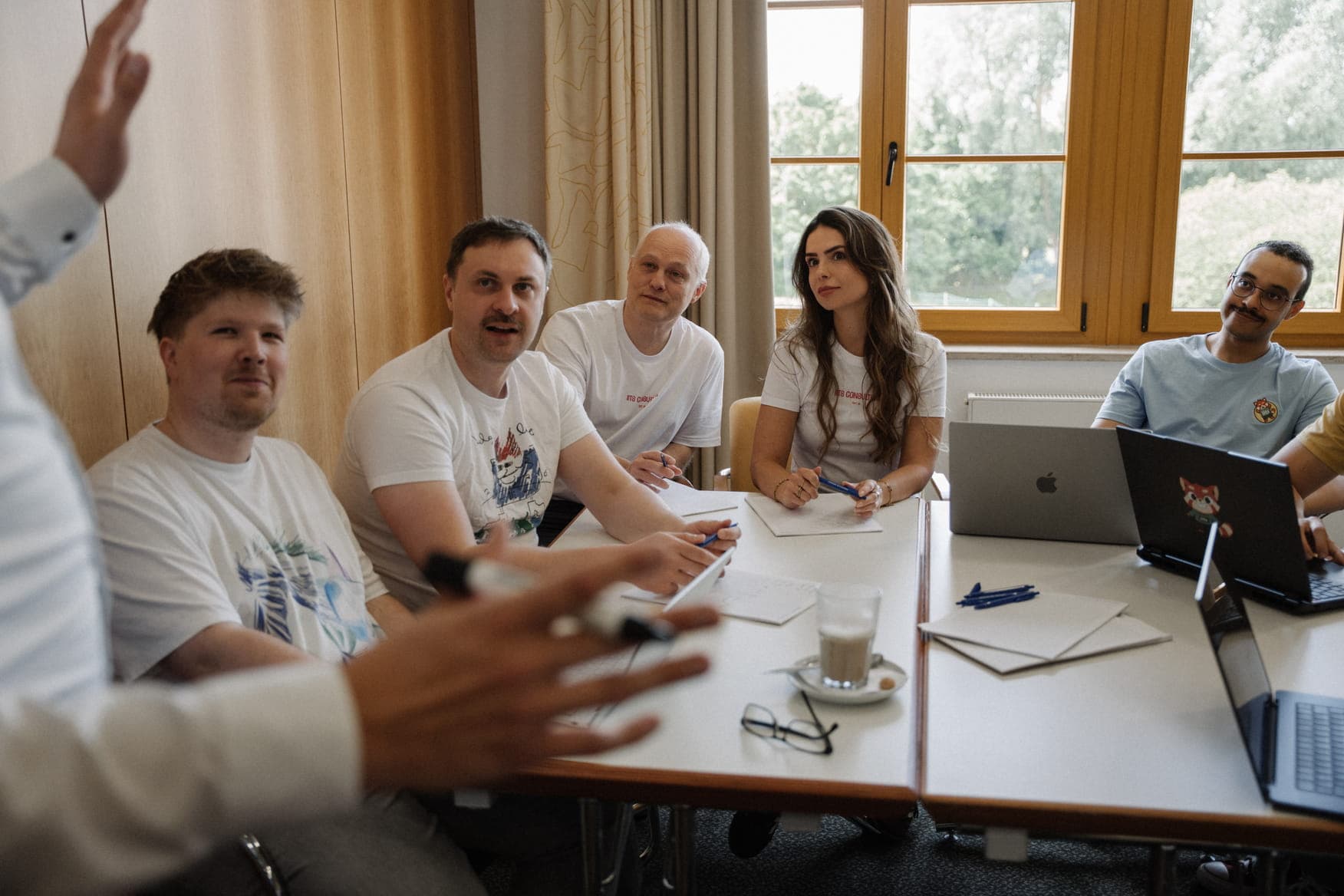
A small group sits around a conference table in a meeting room, listening to a speaker and taking notes with laptops and pens.

Benefits of our Analysis Team

Our analysts work closely with the development teams every day. That is how they know exactly which specification can be built and which only creates more questions. The result is implementation ready requirements that flow straight into your backlog rather than gathering dust as a document full of potential in some archive.

Send Inquiry
  • Documented current processIncluding the informal steps.
  • Prioritized requirements catalogueFunctional and nonfunctional, traced back to business goals.
  • Epics & user storiesWith acceptance criteria, ready for implementation.
  • Target process designWith the planned changes and their expected impact.
  • Clear KPIs & measurable goalsMetrics that truly show whether something succeeded.
  • An honest list of open pointsRisks, assumptions, decisions and who has to make them.

How we work with you

  1. Step 01

    Understand the context

    We review the starting point, the target picture and the system landscape.

  2. Step 02

    Capture people & processes

    Structured stakeholder and user interviews, plus the process as it is actually lived, including existing workarounds.

  3. Step 03

    Clarify requirements

    Functional and nonfunctional requirements as user stories with acceptance criteria, each linked to a business goal and prioritized.

  4. Step 04

    Hand over into delivery

    A refined, estimated backlog plus approachable analysts for your teams.

How AI supports our work

We use AI where it improves the analysis. That includes condensing interviews and tickets into meaningful themes, or surfacing contradictions between documents that cannot be extracted side by side at speed. It also includes drafting first versions of user stories that a human then sharpens, or checking a set of requirements for gaps. These are all tasks that a targeted use of AI makes genuinely more effective. The judgement stays with the analyst and, of course, with you. The biggest lever that LLMs create is the speed at which relevant information can be brought together. Connections, overlaps and blind spots become visible in no time and can therefore be worked into solution spaces earlier.   


Hands type on a laptop at a wooden table while someone nearby points at the screen.
I just want fully worked out user stories’ aims too high and is not realistic. As consultants we guide the customer to the goal and help with the requirements analysis.
Christoph AufmhoffChristoph AufmhoffFounder & CEO

Ideas become impact.

Want to make something happen? Let us start together.

AVG. RESPONSE TIME < 1 BUSINESS DAY