
Digital Twin Architecture for Mobile EV Fast Chargers
A digital twin that gives Uniper's team real-time visibility and control over a fleet of mobile EV fast chargers, from edge to cloud.

- Client
Uniper AG
- INDUSTRY
Energy & Utilities
- SERVICES
AI & IoT
- Location
Düsseldorf
Overview
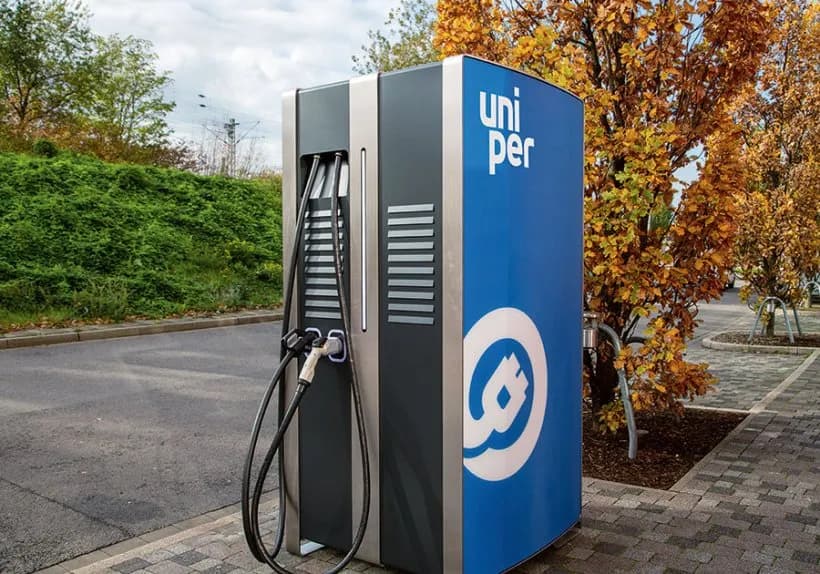
Uniper AG is a leading international energy company with operations across power generation, energy trading, and infrastructure. As part of its activity in the EV space, Uniper runs two mobile fast chargers (MFCs) that support the growing charging ecosystem. To get the most out of these units, the setup needed more than the hardware alone: a connected, edge-cloud hybrid system that manages the chargers intelligently while keeping people in oversight.
Challenge
Operating a distributed fleet of mobile EV fast chargers comes with a complex set of operational demands. Each charger is an IoT device deployed in the field, often in dynamic or remote locations, making physical inspection and manual troubleshooting costly and slow.
Uniper faced three interconnected challenges:
- No real-time visibility into device health, making it difficult to detect and diagnose errors before they impacted availability.
- High operation efforts in logistics and device management, as transport orders and deployment processes required manual coordination with logistics partners. This created inefficiencies and slowed down operational workflows as the fleet scaled.
- Logistics inefficiency, with no predictive model to optimize where and when chargers were deployed across locations.
The absence of a unified, intelligent architecture meant operational teams were reactive rather than proactive, a significant limitation for a rapidly scaling EV infrastructure.
Our Solution
Uniper has partnered with our team at iits-consulting to design and implement a Digital Twin Architecture for their fleet of mobile EV fast chargers. This scalable, cloud-connected solution replaces fragmented, manual operations with a unified platform that gives operations team full visibility and control over every device in the field in real time.
At the device level, each charger is equipped with an on-site edge computing unit that continuously collects sensor data, monitors hardware status, and runs AI-powered anomaly detection locally. This means faults can be identified and flagged immediately, without waiting for data to reach the cloud. A secure, bidirectional connection to the cloud enables remote monitoring and control, so teams can diagnose and respond to issues from anywhere. Implemented remote control capabilities include changing device settings, triggering emergency shutdown, rolling out advertisements, adjusting screen brightness, and controlling LEDs.
In the cloud, a purpose-built IoT platform ingests data from the entire fleet, routes it through dedicated services for enrichment, event detection, and process management, and makes it available to operations teams through intuitive web applications. A fully simulated device environment was built in parallel with the physical hardware, allowing the team to develop and stress-test the entire IT infrastructure at scale. This proved that the platform was ready to handle a fleet of 1,000 devices at a time when only a limited number of hardware prototypes were available.
Machine learning models are integrated throughout the platform to forecast charger demand by location and time, enabling smarter logistics decisions and more efficient fleet positioning across Uniper’s network.
Business Impact
Live monitoring and remote diagnostics reduced the need for on-site interventions, improving fleet uptime and operational response time.
Virtual commissioning capability enabled faster, risk-free rollout of new devices and configurations decoupling testing from physical deployment.
ML-driven logistics optimization improved charger placement decisions, increasing fleet utilization efficiency.
A scalable, reusable IoT cloud architecture was delivered, applicable across other asset types and beyond the EV charging use case (industrial equipment, buildings, and more).
The microservices-based design ensures the platform can scale independently per service, supporting Uniper’s long-term growth in e-mobility infrastructure.
Our Work
View all AI & Machine Learning
 Software Development
Got a problem we can solve?
Start with a no-obligation project inquiry and our team will advise you thoroughly on your project.