The Russia-Ukraine War and the US/Israel-Iran Conflict
Date: 26 August 2026
Executive Summary
Two supply shocks are now hitting the global gas market from opposite directions – one structural and largely permanent (Russia), one acute and geopolitically driven (Iran and the wider Middle East). The Russia-Ukraine war has permanently displaced Russian pipeline gas from Europe and forced a structural pivot to seaborne LNG, concentrated on US supply. The US/Israel-Iran conflict then struck the LNG side of the market – via the Strait of Hormuz and damage to Qatari export infrastructure – precisely when Europe had become dependent on it. The combined effect is a market that is more volatile, more exposed to maritime chokepoints, and structurally tighter than pre-conflict forecasts assumed. The 60-day US-Iran memorandum of understanding expired on 17 August with no negotiations ever having started[1]; Qatari exports are running at roughly half of pre-conflict capacity; and EU storage, at about 60% in mid-August, is at the weakest seasonal position in the AGSI+ record. The decisive development since is that Washington has substituted economic escalation for military escalation: on 24 August the Treasury launched „Operation Economic Outcast“, a secondary-sanctions campaign that US officials describe as the main line of action against Iran until at least after the November midterms.[2] For gas the critical detail is the accompanying OFAC guidance, which makes complying with Iran’s Hormuz transit regime a sanctions risk in itself – so a cargo must now choose between a corridor that is legally hazardous and one that is physically dangerous.[3] Both were tested in the same week: a tanker was disabled on the US-escorted southern route on 24 August, and Iran blacklisted 45 vessels, LNG carriers among them, for breaching its transit rules.[4] The base case for the early winter is therefore neither war nor peace, but a chokepoint that stays contested and administered under two incompatible rule sets.
1. The Russia-Ukraine Shock: Now Structural and Largely Irreversible
Russian piped gas deliveries to the European Union fell by roughly 90% between 2021 and 2025, and the Ukraine transit route was shut at the start of January 2025.[5] The December 2025 political agreement has since become binding law. The REPowerEU gas regulation entered into force on 3 February 2026, the stepwise import ban began to apply on 18 March 2026, and the remaining volumes fall away in two steps – Russian LNG at the turn of 2026/27 and pipeline gas in autumn 2027, with November 2027 as the outer limit.[6] [7]
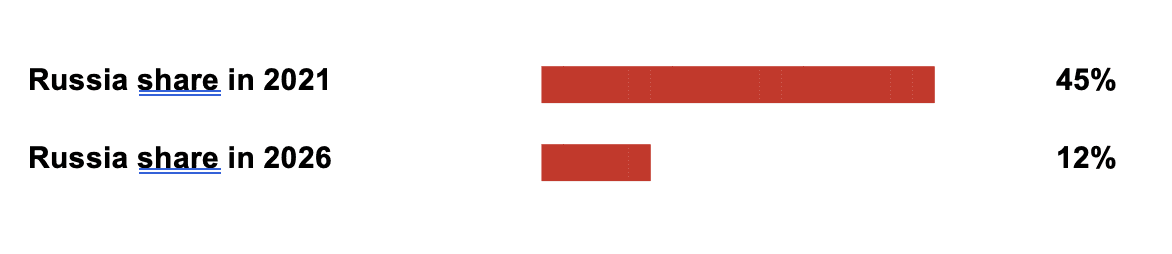
Russia now accounts for only about 12% of EU gas imports, down from around 45% in 2021.[8] The path is not perfectly linear: ACER’s first monitoring report under the new regulation, published on 1 July 2026, found Russian pipeline imports up roughly 7% and LNG imports up roughly 11% year-on-year in the opening months of 2026, as buyers accelerated deliveries under existing contracts ahead of the stricter cut-off dates rather than because the rules had loosened.[9] The strategic significance is nonetheless that this is no longer a reversible swing: even if a Ukraine peace settlement is reached, the phase-out is expected to remain in place. Two referenced reasons support that. The first is legal form: the Council and Parliament deliberately used a regulation rather than sanctions, and the Council’s own communication on the December 2025 deal makes the argument explicitly – sanctions are temporary measures requiring renewal every six months, whereas a regulation is permanent and would need a fresh legislative act, and therefore a qualified majority, to unwind.[10] The second is commercial and reputational: Forbes‘ July 2026 assessment of post-war energy concludes that even if sanctions are lifted, Russia’s record as a supplier will give investors pause and „no one in Brussels is eager to recreate the vulnerability that made the continent a hostage to Gazprom“, while US exporters holding long-term European offtake have no interest in Russian volumes returning.[11] One counterpoint belongs in the record rather than in the claim: Reuters has reported US-Russian discussions – denied by the Russian Direct Investment Fund – about American help in reviving Russian gas sales to Europe as part of a peace package, and the Atlantic Council has argued that any return would have to be routed through Ukraine. That is a tail risk to be monitored.[12] Russia has effectively lost its premium European market and is redirecting volumes to China and India at a discount, shifting long-term pricing power and pipeline politics eastward.
Figure 1 — Russia’s share of EU gas imports (2021 vs. 2026)
2. Europe’s Pivot to LNG: Trading One Dependency for Another
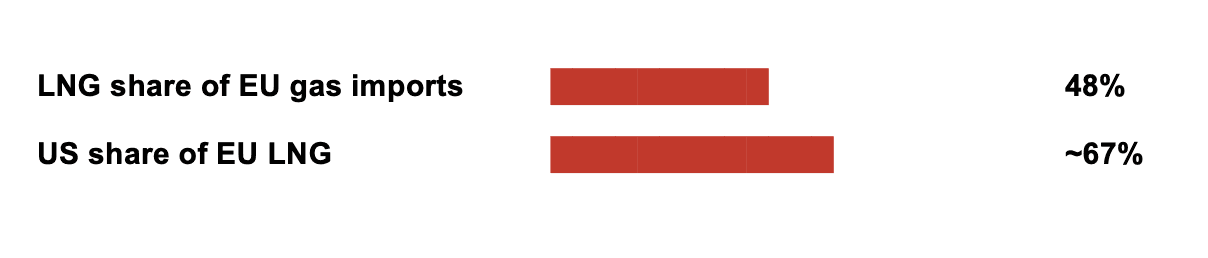
Europe replaced lost pipeline gas primarily with liquefied natural gas. LNG now represents roughly 48% of EU gas imports,[13] imports reached an all-time high over the 2025/26 winter, and Europe is forecast to source about two-thirds of its LNG from the United States in 2026 – having more than tripled US LNG imports since 2021.[14]
Figure 2 — Europe’s LNG dependency, 2026
Kpler forecasts European LNG imports rising toward 145 million tonnes in 2026, with Northwest Europe leading as Germany, Belgium and the Netherlands expand regasification capacity.[15] This „Atlanticization“ of supply ties European gas – and, because power prices remain coupled to gas, European electricity – directly to the global LNG spot market and to US export and pricing policy.[16]
3. The Iran Conflict: An Acute Shock to the LNG Market
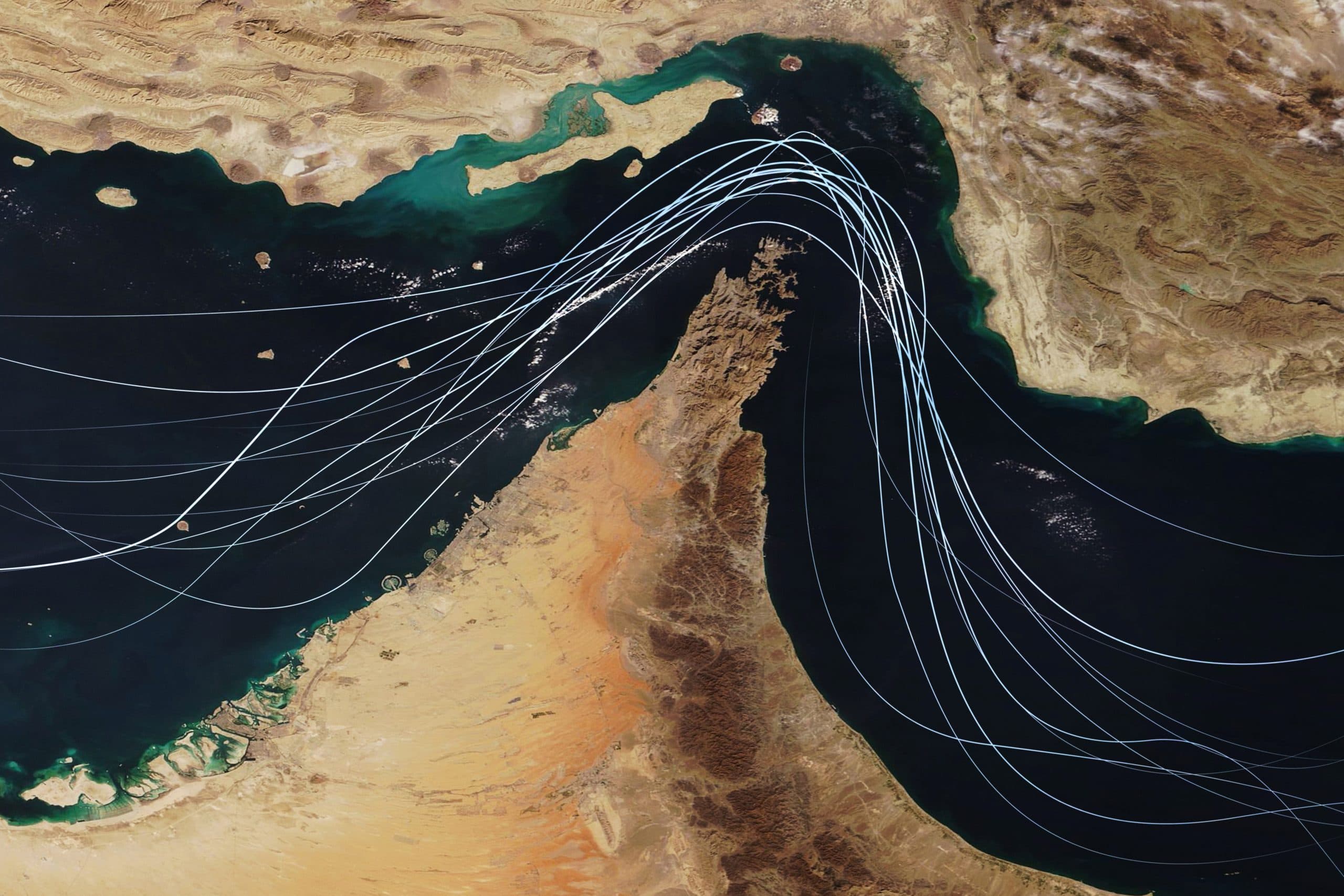
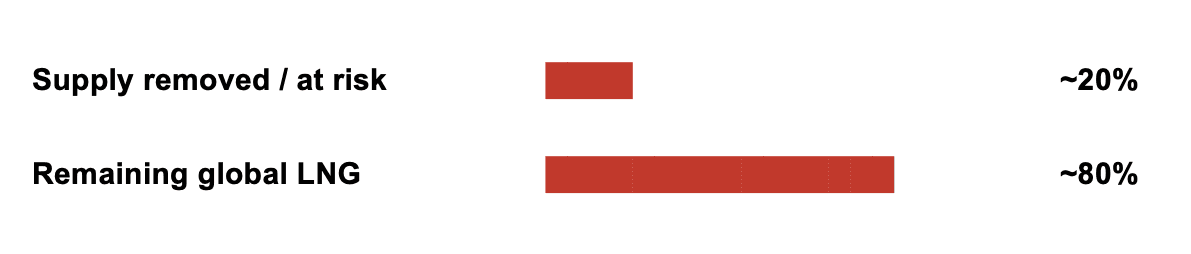
The US/Israel-Iran conflict hit the LNG side of the market just as Europe had become reliant on it. Iranian forces declared the Strait of Hormuz closed on 4 March 2026, and commercial transit largely ceased – stranding the close to 20% of global LNG that must pass through it and driving gas prices in both Asia and Europe to their highest levels since the 2022/23 energy crisis induced by Russia’s attack on Ukraine. Nearly six months on, the disruption is best described as intermittent and politically administered rather than absolute, and it has not been resolved: the 14-point, Pakistan-brokered US-Iran memorandum of understanding signed on 17 June 2026, which opened a 60-day negotiating window and committed Iran to arrange free passage for commercial vessels, [17]briefly reopened flows and triggered a sharp sell-off, then unravelled within ten days: vessels following the US-backed Omani route were struck at the end of June, the US resumed strikes on 27 June, Trump declared the agreement „over“ on 7 July, and Tehran suspended its own commitments in turn. The memorandum formally expired on 17 August 2026 without a single negotiating session having taken place. Iran’s foreign ministry called the 60-day deadline „entirely moot“ and both capitals dismissed it as meaningless. Tehran’s stated position, restated publicly by Ghalibaf (Speaker of the Parliament of Iran), is that the strait stays closed until Washington lifts the naval blockade, unfreezes Iranian assets, eases sanctions and halts military operations on all fronts. Operationally the market is no better off than in July: the Qatari-owned LNG carrier Al Rekayyat was struck near the strait on 7 July, halting Qatari transits for three weeks until a cargo bound for Pakistan crossed at the end of the month; a second LNG tanker was hit in early August, widening the force majeure; QatarEnergy has paused its Ras Laffan ramp-up and is holding the plant at minimum safe rates; and more than 25 GCC energy companies have now declared force majeure.[18]
Figure 3 — Global LNG supply exposed to the Hormuz closure
3.1 Chokepoint concentration
The episode exposed the Strait of Hormuz as the single most dangerous vulnerability in the LNG map: Qatar and, in practice, the entire UAE must transit it – roughly 93% of Qatari and 96% of Emirati LNG exports pass through the strait, together some 19-20% of global LNG trade.[19] The UAE has no seaborne alternative for gas today. It liquefies at Das Island (~6 MTPA) inside the Gulf, and the 9.6 MTPA Ruwais expansion due in 2028 sits inside the Gulf as well. The east-coast option that would genuinely bypass the strait, an LNG export terminal at Fujairah, is the one to watch, and the reporting on it is contradictory: described as shelved in favour of Ruwais, then revived in June, and taken up again by ADNOC Gas in August after Hormuz disruption halved its first-half profit. Nothing has been sanctioned, and on any plausible schedule it is a post-2030 answer to a 2026 problem. The UAE bypass that does exist today – the 1.8 million b/d pipeline to Fujairah, now being expanded – moves crude, not gas.[20] A regional conflict can therefore instantly compete away the Atlantic cargoes Europe relies on, because Qatar’s usual Asian buyers – China, India, Japan and Korea – scramble for alternative supply, pulling US and other Atlantic LNG eastward and raising Europe’s marginal price even though Europe imports little Gulf gas directly. Transit is also bifurcating rather than simply reopening, and the bifurcation is now being formalised. Iran presses for an authorised corridor on its side of the strait, policed through tanker authorisation requirements and proposed transit fees, while the United States escorts shipping along the protected southern route off the Omani coast and CENTCOM reports having redirected 48 commercial vessels, boarded two and disabled two more under the blockade. Iran and Oman have been negotiating a transit regime for two months under Article 5 of the memorandum, which assigned Tehran the task of defining the strait’s „future administration“ in consultation with Oman and the other littoral states. On 2-5 August both sides said the talks were in their final stage: the geographical coordinates of a route running through Iranian and Omani territorial waters have been agreed, a joint declaration is in drafting, Oman called the talks „positive and constructive“ and Iran’s foreign minister (Araghchi) said a deal was „very close“. As of late August the declaration still had not been signed. [21] The two sides have issued a joint statement reaffirming safe passage and set up a joint foreign-ministry working group, and Iran’s deputy foreign minister describes the framework – which would include a joint coordination centre to manage traffic and collect information from vessels – as close to final rather than final.[22] An agreed corridor is not the same as an open strait, however – Tehran has attached conditions beyond the route, including compensation and sanctions relief. However, Washington will not accept an outcome that leaves Iran as gatekeeper of commercial navigation, and on 17-18 August Trump threatened to bomb Oman if it „gets in the way“, having already warned Muscat in May. The mediator is now under pressure from both parties, which is itself a reason to discount quick implementation – and the agreement taking shape is, as CNN put it on 5 August, not the one Washington wants, because any Iranian-Omani condominium over the strait concedes precisely the gatekeeper role the US refuses to accept. [23] [24] Hormuz crossings were running some 70% below the 7 June-7 July truce level at the start of August. [25]More recent traffic data show the Iranian corridor becoming the default rather than the exception: in the week to 25 August Kpler counted 121 crossings, with laden transits down 26%, sanctioned crossings up from nine to sixteen, and the share of vessels using Iran’s routing scheme rising to 46.3%; fewer than 20 commodity vessels crossed over the preceding weekend.[26] The operative question is therefore not whether Hormuz is open, but which corridor a given cargo can use and on whose terms – and, since the memorandum lapsed on 17 August, whether either side has an incentive to settle that before the US midterms on 3 November. On the available evidence a de facto truce before the midterms is possible but is not the base case, and expert opinion is openly split. The case for one is domestic: Trump campaigned on lower energy costs, his opponents are making the war and the price of energy central to a contest in which control of the Senate is at stake, and both the Omani channel and Pakistan’s attempts to restart direct talks remain live. The case against is that Tehran reads the same calendar in reverse. Analysts at the Center for International Policy describe Iran weighing depleted US missile stockpiles and the domestic political cost of the war, and Middle East specialists note that Iran has stopped treating the strait as one item to negotiate and now treats it as the leverage under which sanctions relief and the blockade are negotiated – which argues for holding the chokepoint until the political price for Washington peaks, not for releasing it beforehand. Some commentators go further and expect a renewed US-Israeli strike in early October rather than a deal, and former US officials see „no sign“ of the memorandum being revived. That assessment now has firmer ground under it, and it has shifted in one respect. US officials have said the expanded secondary sanctions announced on 24 August are expected to be the main course of action against Iran until at least after the midterms, when a new military campaign could again be on the table.[27] That makes a pre-election military escalation less likely than the early-October scenario some commentators sketched, and moves the escalation risk to the far side of 3 November – while doing nothing to reopen the strait. The real change on the other side is Iranian. On 22 August President Pezeshkian said publicly that it was „better that we bring the war to an end now as we are in a position of power and dignity“, and the chief negotiator, Ghalibaf, has warned domestic business audiences that Iran cannot sustain its security without a functioning economy.[28] With the rial at a record low of two million to the dollar and the blockade cutting off most oil exports, economic exhaustion is now the most plausible route to a deal – though Tehran simultaneously threatens to retaliate against states that cooperate with the sanctions, which is the route to further restriction of the strait.[29] Therefore a negotiated de-escalation before the US midterms is upside risk rather than the base case. The near-term escalation is economic rather than military. The sharpest military risk sits after 3 November. The working assumption through the injection season and into the winter should be continued „no war, no peace“ with intermittent, politically administered – and now legally bifurcated – transit. One further consequence of the 24 August package deserves separate treatment, because it changes the character of the chokepoint problem from physical to legal. Alongside the designations, OFAC (US Office of Foreign Assets Control) issued guidance on the sanctions risks of acceding to Iranian demands relating to Hormuz shipping. Toll payments to the Iranian state or the IRGC (Islamic Revolutionary Guard Corps) for safe passage are not authorised for US persons or US-owned or -controlled foreign entities in any form – fiat currency, digital assets, offsets, informal swaps or in-kind – and, regardless of whether payment is made, US persons may not receive safe-passage services from the Government of Iran.[30] The reach extends past payment: OFAC has designated the Persian Gulf Strait Authority, the Persian Gulf Marine Insurance Company and HormuzSafe Marine Services Authority, and warns that accepting insurance or other services from them – or merely responding to their information demands for a guarantee of safe passage – carries exposure even where no value changes hands.[31] Since Iran’s scheme requires a transit request before entry, the practical effect is that the compliant way to use the Iranian corridor is itself a sanctionable act, and the joint coordination centre Iran and Oman are proposing would collect exactly the vessel information OFAC has just warned against supplying. The five new sector determinations under Executive Order 13902 – digital assets, technology, gold, aviation and shipping – compound this by exposing any person operating in Iran’s shipping sector to secondary sanctions regardless of commodity class. Owners are left choosing between a northern route that risks US designation and a southern route that risks Iranian missiles[32]: a tanker was disabled off Oman on the US-administered route on 24 August, and the same day Iran blacklisted 45 vessels – very large crude carriers, LNG and LPG carriers and clean-product ships for breaching its rules, with a ship-to-ship transfer to a listed vessel enough to earn a listing of one’s own.[33] Three consequences follow for gas. Freight, insurance and legal cost for Gulf LNG now rises independently of the physical security situation and rises for entirely non-Iranian cargo. Enhanced per-voyage due diligence is no longer best practice but an explicit OFAC expectation, which raises the value of the compliance capability discussed in section 5.4. And enforcement is genuinely uncertain: Washington held back the harshest secondary measures, gave governments undefined timelines and has a Xi state visit scheduled for 24 September, while Beijing has said it will defend its right to trade with Iran – so the market read the announcement as less disruptive than feared, and both crude and TTF sold off on 25 August.[34] [35]
3.2 Medium-term tightness undercuts the expected glut
The damage to Qatari liquefaction infrastructure is now better known: two Ras Laffan trains of roughly 12.8 MTPA combined – about 17% of Qatari capacity – were physically destroyed; QatarEnergy has guided to a three-to-five-year repair, constrained less by construction than by the lead times of the handful of OEMs that make the refrigeration-compressor turbines. The nearer-term commercial priority is restoring the 64 MTPA of undamaged capacity, not rebuilding the two lost trains.[36] [37] QatarEnergy’s force majeure declarations remain in effect and have been extended: market participants had expected a lift by August or September, and the target has since slipped to October.[38] Energy Aspects puts 2026 Qatari exports at about 38.7 Mt, roughly half of pre-conflict capacity; Energy Vista is materially more pessimistic, at slightly under 30 Mt for the year – nearer 39% of the ~77 MTPA pre-conflict base. The spread between the two forecasts is itself a measure of how little forward visibility the market currently has.[39] [40] On a four-year repair horizon this could still cost up to roughly 70 bcm of output by 2030.[41] This partially cancels the large 2026-2027 „LNG wave“ – global LNG supply had been set to grow about 7% (40+ bcm) in 2026, roughly 85% of it from North America – that was expected to loosen the market and push the European TTF benchmark down toward the ~$10/MMBtu (€29.25/MWh) area.[42] That loosening has not materialised. [43]TTF front-month traded at about €59/MWh on 31 July, some 30% above the end-June level, and has firmed further since the memorandum expired: TTF reached €68.46/MWh on 24 August, its highest in about three and a half years, before falling back below €67 and then to roughly €64 on 25 August as the sanctions package was read as less disruptive to physical supply than feared.[44] That single week both confirms how tight the market is and illustrates how violently a policy headline now moves the curve. The market is staying tighter and more volatile than pre-conflict forecasts assumed. Whether the glut is merely delayed or structurally cancelled is open, however: more than 120 MTPA of US liquefaction is under construction, roughly 52 MTPA of it due to reach the market in 2027 alone, with Canada adding some 20 MTPA by the end of the decade. On that reading the Qatari loss is absorbed rather than compounded, and the tightness described here is a two-to-three-year phenomenon rather than a new equilibrium. That reading has one significant hole. Qatar’s own 32 MTPA North Field East expansion, previously targeted for late 2026, has stalled – QatarEnergy’s chief executive has said no work is taking place and the project could slip by more than a year – so the war has taken capacity out of the 2027-2028 growth profile as well as out of current output.[45] [46]
The immediate consequence is a storage problem.[47] EU inventories opened the injection season on 1 April at about 28% of capacity, the lowest in four years, and have refilled into the weakest seasonal position on record: 57.2% (645.965 TWh) on 2 August, the lowest early-August reading in the AGSI+ series and, on Bloomberg’s reading, an 18-year seasonal low, roughly 11 percentage points below the same point in 2025. By 15 August the level had reached about 60.4%, still some 9-10 percentage points below the five-year norm. The 2026 filling target was itself lowered from 90% to 80% by 1 November, and the Commission has allowed individual member states to go as low as 70% rather than force panic buying. The arithmetic is finely balanced rather than hopeless: injections are now running at roughly the +0.25 percentage points per day needed to reach about 80% by 1 November, so the target is reachable – but only on uninterrupted LNG arrivals, and ACER’s assessment is that meeting it requires LNG imports at least at 2025 levels, with around 13% more needed for the old 90% mark. Europe therefore has to buy heavily into an already tight summer market, which is precisely what is supporting TTF. The consequence for the winter is that Europe will carry the thinnest buffer since the 2022 crisis into the heating season, with correspondingly less room to absorb a cold spell, a supply outage or a further Hormuz escalation.[48]
Figure 4 — 2026 LNG supply wave vs. potential Qatari loss (bcm)

4. Net Strategic Implications
- Volatility is now the baseline, not the exception. A geopolitical risk premium is structurally embedded in European gas and power prices, with knock-on effects on industrial competitiveness and the cost of living.[49]
- Dependency has been reshaped, not eliminated. Diversification cut Russian risk but concentrated US-supply and maritime-chokepoint risk. The US is now the dominant supplier – and Europe’s supplier concentration is arguably higher than in 2021. The United States provides roughly two-thirds of EU LNG imports, about 63% in the first quarter of 2026, a larger share than Russian pipeline gas ever held of total EU imports.[50] What changed is the character of the dependency rather than its degree. Russian pipeline gas was a physically captive relationship with a supplier willing to weaponize it. US LNG is contractual, redirectable and politically friendlier, but it remains a single-jurisdiction concentration exposed to US export policy, Henry Hub economics and Atlantic shipping – and the July methane climbdown (the EU’s decision to suspend EU methane penalties) shows how quickly that concentration converts into regulatory leverage. Europe’s resilience can no longer be delivered through supplier diversity (on the short run), which is why it now has to rest on storage mandates, regasification buildout and demand flexibility instead. The crisis has also vindicated multi-energy hedging: buyers are diversifying not only across suppliers but across fuels, delivery points, shipping routes and contract and price structures.[51]
- Winners and losers have shifted. US and other Atlantic exporters gain structural share; Asian importers and Europe increasingly compete for the same cargoes; Russia loses Europe permanently and pivots to discounted Asian sales. Qatar, however, is not simply a loser: QatarEnergy’s merchant share of Golden Pass in the US (12.6 MTPA) is roughly equivalent to the volume lost at Ras Laffan, and as the world’s lowest-cost supplier it retains the pricing flexibility to fight back into Asian market share once transit normalises. On the question of Qatari-Iranian coordination the Washington Post reported that Qatar approached Iran early in the war offering to halt its own gas production if Tehran spared a key energy complex – the logic being that a Qatari production halt would send prices soaring and force Washington and Israel to end the conflict. Doha did not let that stand: Qatar’s International Media Office rejected the report outright, said it had never coordinated with Iran on energy during the war, and called it „baseless“ to suggest Qatar had exaggerated or fabricated the Ras Laffan damage. The subsequent facts also cut against a standing understanding: Iran struck Ras Laffan and other Gulf gas infrastructure on 18 March in response to Israel’s targeting of a major Iranian gas field, Qatar said the strikes had crossed „all red lines“, and Iranian diplomatic, military and security staff were expelled from Doha at 24 hours‘ notice. The defensible version is therefore an attempted arrangement that failed rather than a quiet deal that held.[52] That removes the implication that the outage is a negotiated variable and puts the roughly 17% of Qatari capacity lost down to military damage – while leaving the narrower point intact, that Doha’s Golden Pass position gives it a hedge against its own outage.[53] [54]
- The energy transition is reframed as security policy. Both shocks strengthen the case for accelerating domestic renewables, grid buildout and energy efficiency. Energy security, not only decarbonization, is now a primary driver of the energy transition – though the near-term direction of travel runs the other way: environmental priorities have become less prominent as governments concentrate on physical supply and affordability, visible in the July 2026 decision to suspend EU methane penalties. On whether the EU can realistically enforce those rules, particularly against the United States, the record now suggests not – at least not this decade. On 20 July 2026 the Commission issued two Recommendations under Regulation (EU) 2024/1787: one setting out how importers may demonstrate compliance, including optional model contractual clauses and third-party solutions, and one advising member states to refrain from applying penalties for importer breaches falling due in 2027, 2028 and 2029, fraudulent breach excepted. The Commission’s own justification cited security of supply „in a context of global energy markets tightness caused by the ongoing blockade of the Strait of Hormuz“, and the step followed direct US pressure to roll the rules back. The binding technical obstacle – MRV equivalence for US-origin volumes – was not resolved but deferred. Two structural points follow. Recommendations are non-binding, so enforcement has not been repealed but made discretionary, which industry itself argues leaves legal uncertainty that only a targeted amendment can settle. And a rule whose enforcement is suspended as soon as the supply position tightens is not a constraint on the dominant supplier; it is a bargaining chip that the supplier has already cashed. The planning implication is to treat EU methane requirements as a documentation and compliance cost rather than a penalty risk before 2030, while noting that the suspension is time-limited, non-statutory and reversible if the market loosens.[55] [56]
5. Where AI Creates Advantage for Suppliers and Traders
The conditions described above – embedded volatility, chokepoint-driven re-routing, concentrated US supply and a storage position that has to be closed in a tight market – reward speed of interpretation. This is where AI is now delivering measurable value for gas suppliers, portfolio managers and trading desks: not as a price oracle, but to compress the time between a signal appearing and a position, nomination or hedge changing.[57]
5.1 Signal detection and event-driven trading
Large language models combined with vessel-tracking and satellite feeds can monitor Hormuz transit patterns, Ras Laffan loading queues, force majeure notices, regulatory publications and regional news in multiple languages continuously, and translate them into structured, machine-readable events within minutes.[58] In an environment where a single diplomatic headline repriced the curve in June 2026 and reversed it in July, the desk that recognizes the pattern and its historical analogue first captures most of the move. The same pipeline also filters noise, which matters more than detection: most headlines in a crisis market are not tradeable.[59]
5.2 Forecasting and probabilistic scenario analysis
Machine-learning models trained on weather ensembles, storage trajectories, LNG flow data, freight rates and power-sector demand outperform single-scenario planning in exactly the regime this briefing describes, where the central forecast [60]– the 2026 supply glut – failed. The scale these models require is more modest than the description suggests, and worth stating because it decides build versus buy: the heavy computation sits upstream, not on the desk. The weather input is a numerical weather prediction ensemble and it is produced by meteorological centres, not by trading firms. What a gas desk runs is the post-processing and the downstream learning over that licensed output: statistical calibration of the ensemble, then gradient-boosted or neural mappings from ensemble fields to demand, storage and price. That is a single-server or small GPU-cluster workload retrained daily or weekly, not an HPC programme, and ML emulation is making it cheaper rather than more demanding. The binding constraint is therefore data licensing and pipeline engineering, not compute.[61] The practical output is a distribution rather than a number: probability-weighted TTF and JKM paths, conditional on Qatari repair timelines, Hormuz transit availability and heating-degree-day outcomes. That is what allows a supplier to size its storage injections and its winter hedge to a risk budget.[62]
5.3 Portfolio, cargo and logistics optimization
Optimization under uncertainty is the most immediately monetizable application. Reinforcement-learning and stochastic-optimization engines can re-solve cargo diversion, ship scheduling, regasification slot allocation and storage injection or withdrawal profiles as constraints move, capturing Atlantic-Pacific arbitrage that manual reoptimization is too slow to reach.[63]
5.4 Risk, credit and compliance
The tightening sanctions architecture makes compliance an operational risk. The REPowerEU import ban applies in steps through 2027, and origin, ownership and transshipment histories must be verified per cargo. AI-assisted document review and counterparty screening can check contract clauses, certificates of origin and vessel histories against the current rule set at cargo speed, and flag exposures – force majeure triggers, margin calls, correlated credit risk across counterparties hit by the same shock – before they become losses. Operation Economic Outcast has raised the value of this capability sharply. OFAC now strongly encourages all maritime service providers to conduct enhanced due diligence on any vessel attempting to transit the Strait of Hormuz; the shipping-sector determination exposes counterparties several steps removed from the underlying trade; and Iranian efforts to obscure cargo origin are expected to grow more sophisticated in response. Per-voyage screening of ownership, flag, insurer, routing scheme and ship-to-ship history has therefore become a condition of trading the Gulf at all, at a cadence and volume no manual team can sustain.[64] [65]
5.5 Customer-facing and internal operations
For supply businesses, AI improves the commodity side of the business as well: demand forecasting per customer segment, churn and credit-risk scoring, dynamic tariff and structured-product design, and automated handling of switching, billing and metering queries.[66] Margins in retail gas supply are thin enough that cost-to-serve reduction is a competitive lever in its own right.
Two caveats apply. First, model quality is bounded by data quality and by contractual access to flow, weather and vessel data – the advantage is usually bought in the data layer, not the model layer. Second, in a market with this many regime breaks, models trained on pre-2022 relationships will misprice tail events; human oversight of AI-generated positions is a control requirement, not a preference.[67]
6. Caveat
The Middle East / Strait of Hormuz situation remains fast-moving, and is better held as three branches than as a single forecast: a continuing „no war, no peace“ stalemate – the base case, and arguably the worst outcome for Gulf exporters, since it means persistent uncertainty without resolution; a return to full-scale war; or a comprehensive settlement that would eventually return Iranian volumes to the market and reinforce expectations of long-run abundance.[68] The magnitude of Qatari infrastructure damage and the associated repair timelines are still being assessed, so the acute price impact could ease faster – or persist longer – than current reporting suggests. The June 2026 US-Iran memorandum showed how quickly a diplomatic headline can reprice the curve – and how quickly that repricing can reverse; its expiry on 17 August, with no talks ever having started, is why the base case above is stalemate rather than settlement. The 3 November US midterms are the single most likely catalyst in either direction inside the planning horizon, and the 24 August sanctions campaign has sharpened rather than softened that: US officials present secondary sanctions as the substitute for military action until the election, which defers the military escalation risk to the far side of it while adding a legal and compliance dimension to the chokepoint that did not exist in the spring.[69]
References
- [1]Shamim, S. (2026, August 17). US-Iran Memorandum of Understanding expires: How and why it fell apart. Al Jazeera — https://www.aljazeera.com/news/2026/8/17/us-iran-memorandum-of-understanding-expires-how-and-why-it-fell-apart
- [2]Ravid, B. (2026, August 24). Bessent unveils sanctions designed to cripple Iran. Axios — https://www.axios.com/2026/08/24/bessent-dday-iran-secondary-sanctions
- [3]Office of Foreign Assets Control. (2026). OFAC alert: Sanctions risks of Iranian demands for Strait of Hormuz passage. U.S. Department of the Treasury — https://ofac.treasury.gov/media/935556/download?inline=
- [4]Howard, G. (2026, August 25). OFAC warns Hormuz compliance alone may breach Iran sanctions. Seatrade Maritime News — https://www.seatrade-maritime.com/security/ofac-warns-hormuz-compliance-alone-may-breach-iran-sanctions
- [5]International Energy Agency. (2026c). Gas market report, Q2-2026: Executive summary — https://www.iea.org/reports/gas-market-report-q2-2026/executive-summary
- [6]Council of the European Union. (2026). Timeline: Ending Russian energy imports — https://www.consilium.europa.eu/en/policies/ending-russian-energy-imports/timeline-ending-russian-energy-imports/
- [7]International Energy Agency. (2026b). Gas market report, Q1-2026: Executive summary — https://www.iea.org/reports/gas-market-report-q1-2026/executive-summary
- [8]International Energy Agency. (2026c). Gas market report, Q2-2026: Executive summary — https://www.iea.org/reports/gas-market-report-q2-2026/executive-summary
- [9]European Union Agency for the Cooperation of Energy Regulators. (2026, July 1). Russian gas import contracts and diversification: 2026 monitoring report — https://www.acer.europa.eu/monitoring/russian-gas-phase-out-2026
- [10]Council of the European Union. (2025, December 3). Council and Parliament strike a deal on rules to phase out Russian gas imports for an energy secure and independent Europe [Press release]. The Council states the rationale for using a regulation rather than sanctions directly: sanctions are temporary measures requiring renewal every six months, whereas a regulation is a more permanent measure — https://www.consilium.europa.eu/en/press/press-releases/2025/12/03/council-and-parliament-strike-a-deal-on-rules-to-phase-out-russian-gas-imports-for-an-energy-secure-and-independent-europe/
- [11]Cohen, A. (2026, July 21). Energy after peace in Ukraine. Forbes. The quoted judgement that „no one in Brussels is eager to recreate the vulnerability that made the continent a hostage to Gazprom“ is Cohen’s — https://www.forbes.com/sites/arielcohen/2026/07/21/energy-after-peace-in-ukraine/
- [12]On the reported US-Russian discussions, see US, Russia discuss potential revival of Russian gas exports to Europe, Reuters reports. (2025, May 8). The Kyiv Independent. The Russian Direct Investment Fund denied that such discussions were taking place. For the argument that any return would have to be routed through Ukraine, see Atlantic Council. (n.d.). If Russian gas returns to Europe, it must go through Ukraine — https://kyivindependent.com/us-russia-discuss-potential-revival-of-russian-gas-exports-to-europe-reuters-says/, https://www.atlanticcouncil.org/blogs/energysource/if-russian-gas-returns-to-europe-it-must-go-through-ukraine/
- [13]International Energy Agency. (2026c). Gas market report, Q2-2026: Executive summary — https://www.iea.org/reports/gas-market-report-q2-2026/executive-summary
- [14]International Energy Agency. (2026d). Growth in global demand for natural gas is set to accelerate in 2026 as LNG wave spreads through markets — https://www.iea.org/news/growth-in-global-demand-for-natural-gas-is-set-to-accelerate-in-2026-as-lng-wave-spreads-through-markets
- [15]Kpler. (2025, December 16). European natural gas outlook 2026 — https://www.kpler.com/blog/european-natural-gas-outlook-2026
- [16]Institute for Energy Economics and Financial Analysis. (n.d.). Europe’s electricity prices are still tied to gas, making geopolitics a structural vulnerability — https://ieefa.org/resources/europes-electricity-prices-are-still-tied-gas-making-geopolitics-structural-vulnerability
- [17]Palti-Guzman, L. (2026, August 5). The battle for Hormuz will reshape the global LNG market. Center for Strategic and International Studies — https://www.csis.org/analysis/battle-hormuz-will-reshape-global-lng-market
- [18]International Energy Agency. (2026b). Gas market report, Q1-2026: Executive summary — https://www.iea.org/reports/gas-market-report-q1-2026/executive-summary
- [19]International Energy Agency. (n.d.). Strait of Hormuz. Approximately 93% of Qatari and 96% of Emirati LNG exports transit the strait, together about 19% of global LNG trade. See also Palti-Guzman (2026) — https://www.iea.org/about/oil-security-and-emergency-response/strait-of-hormuz
- [20]How UAE’s Adnoc is building a gas strategy beyond the Strait of Hormuz. (2026, August 3). The National. On the renewed Fujairah study following the halving of ADNOC Gas’s first-half profit, see Adnoc Gas‘ profit halved on Hormuz disruptions – so it’s planning an LNG export route that skips the strait entirely. (2026, August 11). Enterprise — https://www.thenationalnews.com/business/energy/2026/08/03/how-uaes-adnoc-is-building-a-gas-strategy-beyond-the-strait-of-hormuz/, https://enterpriseam.com/uae/2026/08/11/adnoc-gas-profit-halved-on-hormuz-disruptions-so-its-planning-an-lng-export-route-that-skips-the-strait-entirely/
- [21]Al Jazeera. (2026, August 5). Iran says Hormuz talks with Oman in „final“ stages as route approved — https://www.aljazeera.com/news/2026/8/5/iran-says-hormuz-talks-with-oman-in-final-stages-as-route-approved
- [22]Al Jazeera. (2026, August 5). Iran, Oman, US „close“ to Hormuz deal: What do they all want? On the joint statement and the joint foreign-ministry working group, see Ministry of Foreign Affairs of the Sultanate of Oman. (2026). Oman and the Islamic Republic of Iran issue a joint statement — https://www.aljazeera.com/news/2026/8/5/iran-oman-us-close-to-hormuz-deal-what-do-they-all-want, https://www.fm.gov.om/en/48943/
- [23]Trump threatens to bomb Oman if it impedes US-Iran Strait of Hormuz talks. (2026, August 17). Euronews. See also Trump threatened to bomb Oman because he’s unhappy with country’s deal with Iran, officials say. (2026, August 18). The Washington Post — https://www.euronews.com/2026/08/17/trump-threatens-to-bomb-oman-if-it-impedes-us-iran-strait-of-hormuz-talks, https://www.washingtonpost.com/world/2026/08/18/oman-iran-war-us-hormuz/
- [24]An agreement on the Strait of Hormuz is taking shape – but not one Trump wants. (2026, August 5). CNN — https://edition.cnn.com/2026/08/05/middleeast/hormuz-iran-oman-agreement-analysis-intl
- [25]Palti-Guzman (2026), on the emergence of an Iran-authorised corridor alongside the US-protected southern route off the Omani coast; the 70% decline in crossings relative to the 7 June–14 July truce period is attributed there to Kpler — https://www.csis.org/analysis/battle-hormuz-will-reshape-global-lng-market
- [26]Howard (2026), citing Kpler transit data for the week to 25 August 2026 — https://www.seatrade-maritime.com/security/ofac-warns-hormuz-compliance-alone-may-breach-iran-sanctions
- [27]Ravid (2026). US officials are reported there as saying the expanded secondary sanctions „are expected to be the main course of action against Iran until at least after the midterm elections, when a new military campaign could again be on the table“ — https://www.axios.com/2026/08/24/bessent-dday-iran-secondary-sanctions
- [28]Iranian president says time to end war with US from „position of strength“. (2026, August 22). Al Jazeera. Ghalibaf’s warning that Iran „will not be able to sustain its security without a strong economy“ is reported in Ravid (2026) — https://www.aljazeera.com/news/2026/8/22/iranian-president-says-time-to-end-war-with-us-from-position-of
- [29]Ravid (2026), on the rial’s fall to two million to the US dollar and the effect of the naval blockade on Iranian oil exports; and Xu (2026), on Iranian threats to retaliate against states that cooperate with the sanctions campaign — https://www.axios.com/2026/08/24/bessent-dday-iran-secondary-sanctions
- [30]Office of Foreign Assets Control. (2026, May 29). 1249. Are „toll“ payments to Iran for safe passage through the Strait of Hormuz authorized? Is receiving guarantees or services from Iran for or related to safe passage authorized, even when no payment is made? [Frequently asked question]. U.S. Department of the Treasury. OFAC notes that demanded payment may take the form of „fiat currency, digital assets, offsets, informal swaps, or other in-kind payments“ — https://ofac.treasury.gov/faqs/1249
- [31]Howard (2026), quoting the OFAC alert: US and non-US persons risk sanctions or penalties by engaging with the designated Persian Gulf Strait Authority, Persian Gulf Marine Insurance Company and HormuzSafe Marine Services Authority, „including by accepting insurance or other services or responding to information demands for guarantees of safe passage, even if there is no associated payment or other exchange of value for these services“. The Persian Gulf Strait Authority was designated in May 2026; the other two entities were designated in July 2026 — https://www.seatrade-maritime.com/security/ofac-warns-hormuz-compliance-alone-may-breach-iran-sanctions
- [32]Chalos, G. (2026, August 25). US Treasury’s „Operation Economic Outcast“ elevates sanctions risk for shipping industry. All About Shipping. The five determinations were issued under section 1(a)(i) of Executive Order 13902 with effect from 24 August 2026, building on earlier determinations covering Iran’s financial sector (2020) and its petroleum and petrochemical sectors (2024). The assessment that secondary sanctions now reach anyone operating in Iran’s shipping sector „regardless of commodity class“ is James Neale of HFW, quoted in Howard (2026) — https://allaboutshipping.co.uk/2026/08/25/us-treasurys-operation-economic-outcast-elevates-sanctions-risk-for-shipping-industry/
- [33]Iran threatens 45 tankers with fines, confiscation in Hormuz escalation. (2026, August 24). Business Recorder. The list was published by the Persian Gulf Strait Authority and covers very large crude carriers, LNG and LPG carriers and clean-product vessels. On the tanker disabled off Oman on the US-administered southern route on 24 August, see Howard (2026) — https://www.brecorder.com/news/40436316/iran-threatens-45-tankers-with-fines-confiscation-in-hormuz-escalation
- [34]Xu, C. (2026, August 25). Oil prices fall as US sanctions on Iran posing limited near-term supply risk. Oil & Gas Journal. West Texas Intermediate fell about 2.5% to $84.90/bbl and Brent about 2.5% to $92.00/bbl on 24 August. Rystad Energy’s Jorge Leon is quoted there on the enforcement question; the state visit by President Xi is scheduled for 24 September 2026 — https://www.ogj.com/general-interest/economics-markets/news/55400452/oil-prices-fall-as-us-sanctions-on-iran-posing-limited-near-term-supply-risk
- [35]International Energy Agency. (2026b). Gas market report, Q1-2026: Executive summary — https://www.iea.org/reports/gas-market-report-q1-2026/executive-summary
- [36]Palti-Guzman (2026), citing QatarEnergy’s guidance of three to five years for repair, and 64 MTPA of undamaged capacity to be restored first — https://www.csis.org/analysis/battle-hormuz-will-reshape-global-lng-market
- [37]Wood Mackenzie. (2026, March 19). Ras Laffan attacks fundamentally reshape global LNG outlook as recovery timeline likely significantly extended [Press release] — https://www.woodmac.com/press-releases/new-page6/
- [38]Palti-Guzman (2026), citing Reuters reporting of 23 July 2026 that QatarEnergy extended its force majeure and chartered out tankers into October — https://www.csis.org/analysis/battle-hormuz-will-reshape-global-lng-market
- [39]Palti-Guzman (2026), citing Energy Vista — https://www.csis.org/analysis/battle-hormuz-will-reshape-global-lng-market
- [40]Energy Aspects. (2026). Qatar LNG: Why Hormuz recovery will be slow and uneven — https://www.energyaspects.com/resources/insights/qatar-lng-hormuz-recovery-gradual
- [41]International Energy Agency. (2026c). Gas market report, Q2-2026: Executive summary — https://www.iea.org/reports/gas-market-report-q2-2026/executive-summary
- [42]International Energy Agency. (2026d). Growth in global demand for natural gas is set to accelerate in 2026 as LNG wave spreads through markets — https://www.iea.org/news/growth-in-global-demand-for-natural-gas-is-set-to-accelerate-in-2026-as-lng-wave-spreads-through-markets
- [43]Tacto. (2026b, July 31). Natural gas price: Market update. Retrieved August 26, 2026, from — https://www.tacto.ai/en/energy/natural-gas-price
- [44]EU natural gas. (n.d.). Trading Economics. Retrieved August 26, 2026, from TTF front-month reached EUR 68.46/MWh on 24 August 2026, the highest level in approximately three and a half years, before easing below EUR 67 and closing near EUR 64 on 25 August — https://tradingeconomics.com/commodity/eu-natural-gas
- [45]North Field expansion project delays likely as Qatari LNG output crippled by Iranian attacks. (2026). Natural Gas Intelligence. QatarEnergy chief executive Saad al-Kaabi is reported as saying that no work is taking place at the North Field project and that it could be delayed by more than a year — https://naturalgasintel.com/news/north-field-expansion-project-delays-likely-as-qatari-lng-output-crippled-by-iranian-attacks/
- [46]Palti-Guzman (2026), citing Energy Vista analysis of liquefaction projects under construction, US Energy Information Administration data on 2027 start-ups, and Natural Resources Canada on Canadian export capacity — https://www.csis.org/analysis/battle-hormuz-will-reshape-global-lng-market
- [47]Tacto. (2026a, July 28). Natural gas price: EU storage and filling target. Retrieved August 26, 2026, from — https://www.tacto.ai/en/energy/natural-gas-price
- [48]Europe gas buffer at risk as levels hit 18-year seasonal low. (2026, August 3). Bloomberg. Underlying data are Gas Infrastructure Europe AGSI+. On the LNG import volumes required to meet the filling target, see European Union Agency for the Cooperation of Energy Regulators. (2026). The EU will need higher LNG imports to refill gas storage ahead of winter — https://www.bloomberg.com/news/articles/2026-08-03/eu-s-winter-gas-buffer-at-risk-as-storage-levels-hit-18-year-low, https://www.acer.europa.eu/news/eu-will-need-higher-lng-imports-refill-gas-storage-ahead-winter
- [49]International Energy Agency. (2026a). European gas market volatility puts continued pressure on competitiveness and cost of living — https://www.iea.org/commentaries/european-gas-market-volatility-puts-continued-pressure-on-competitiveness-and-cost-of-living
- [50]Cohen (2026), reporting American exporters at some 63% of EU LNG in the first quarter of 2026 — https://www.forbes.com/sites/arielcohen/2026/07/21/energy-after-peace-in-ukraine/
- [51]Palti-Guzman (2026), key takeaway 5, on the vindication of multi-energy hedging across suppliers, fuels, entry points, shipping access, technologies and contract and price structures — https://www.csis.org/analysis/battle-hormuz-will-reshape-global-lng-market
- [52]Report: Qatar offered to cut gas production in exchange for Iran sparing key facility. (2026). The Times of Israel. Qatar’s International Media Office rejected the report, stating that Qatar had never coordinated with Iran on energy during the war and that it was „baseless“ to suggest Qatar had exaggerated or fabricated the Ras Laffan damage. On the 18 March strikes and Qatar’s response, see Qatar says Iran strikes across Gulf have crossed „all red lines“. (2026). Gulf News — https://www.timesofisrael.com/report-qatar-offered-to-cut-gas-production-in-exchange-for-iran-sparing-key-facility/, https://gulfnews.com/world/gulf/qatar/qatar-warns-iran-strikes-across-gulf-have-crossed-all-red-lines-1.500463070
- [53]Qatar pursued secret talks with Iran to shield gas complex from strikes. (2026, June 12). The Washington Post. — cited in Palti-Guzman (2026), which raises the Golden Pass / Ras Laffan symmetry as an open question rather than an established fact. Qatar subsequently rejected the report on the record, denying any energy coordination with Iran during the war and calling it „baseless“ to suggest it had exaggerated or fabricated the Ras Laffan damage; see note 70. Treat the reported approach as an attempt that failed rather than an understanding that held — https://www.washingtonpost.com/world/2026/06/12/qatar-pursued-secret-talks-with-iran-shield-gas-complex-strikes/
- [54]Palti-Guzman (2026), on QatarEnergy’s 12.6 MTPA merchant share of Golden Pass and Qatar’s position as the world’s lowest-cost LNG supplier — https://www.csis.org/analysis/battle-hormuz-will-reshape-global-lng-market
- [55]EU Methane Regulation: Commission clarifies compliance options and recommends three-year penalty grace period. (2026, August). Herbert Smith Freehills Kramer. The two Recommendations of 20 July 2026 address compliance demonstration and advise member states to refrain from applying penalties for importer breaches arising in 2027, 2028 and 2029, other than in cases of fraudulent breach. On the role of US pressure and the security-of-supply justification, see EU pauses methane penalties amid energy crisis, US pressure. (2026, July 20). Al Jazeera — https://www.hsfkramer.com/insights/2026-08/eu-methan-regulation-eu-commission-clarifies-compliance-options-and-recommends-three-year-penalty-grace-period, https://www.aljazeera.com/news/2026/7/20/eu-pauses-methane-penalties-amid-energy-crisis-us-pressure
- [56]Palti-Guzman (2026), key takeaway 6, that energy security has again moved ahead of environmental considerations — https://www.csis.org/analysis/battle-hormuz-will-reshape-global-lng-market
- [57]Accenture. (2026). AI for commodity trading. . Argues that the binding constraint is no longer access to information but the ability to interpret, prioritise and act on it faster than competitors — https://www.accenture.com/insights/strategy/ai-commodity-trading, https://www.accenture.com/insights/strategy/ai-commodity-trading
- [58]Kpler. (n.d.). Maritime intelligence: Ship tracking and predictive analytics. ; SatNews. (2026, March 2). Kpler Marine leverages real-time AIS data to map “dark fleet” movements amid U.S.-Iran conflict. . On an AIS network of 9,000+ terrestrial and satellite stations, automatic detection of port calls, ship-to-ship transfers and canal transits, and the cross-referencing of satellite AIS with synthetic-aperture radar during the current disruption — https://www.kpler.com/product/maritime, https://satnews.com/2026/03/02/kpler-marine-leverages-real-time-ais-data-to-map-dark-fleet-movements-amid-u-s-iran-conflict/, https://www.kpler.com/product/maritime, https://satnews.com/2026/03/02/kpler-marine-leverages-real-time-ais-data-to-map-dark-fleet-movements-amid-u-s-iran-conflict/
- [59]Boston Consulting Group. (2026). How AI is transforming energy trading. . Notes that LNG and physical liquids differ from power and pipeline gas in that their pain points sit in the work supporting trading rather than in signal generation itself — https://www.bcg.com/publications/2026/ai-transforming-energy-trading, https://www.bcg.com/publications/2026/ai-transforming-energy-trading
- [60]Berrisch, J., & Ziel, F. (2022). Distributional modeling and forecasting of natural gas prices. Journal of Forecasting, 41(6), 1065–1086 — https://doi.org/10.1002/for.2853
- [61]European Centre for Medium-Range Weather Forecasts. (2023). The rise of machine learning in weather forecasting. The operational ensemble comprises one control member and 50 perturbed members. On machine-learning emulation reducing the cost of ensemble generation, and on the Artificial Intelligence Forecasting System (AIFS), see European Centre for Medium-Range Weather Forecasts. (n.d.). Machine learning for numerical weather prediction — https://www.ecmwf.int/en/about/media-centre/science-blog/2023/rise-machine-learning-weather-forecasting, https://www.ecmwf.int/sites/default/files/elibrary/81699-machine-learning-for-numerical-weather-prediction.pdf
- [62]Wu, Z., Zhou, J., & Yu, X. (2025). Forecast natural gas price by an extreme learning machine framework based on multi-strategy grey wolf optimizer and signal decomposition. Sustainability, 17(12), 5249. . Argues that single-point or interval-only models cannot describe the range of plausible price outcomes — https://doi.org/10.3390/su17125249, https://doi.org/10.3390/su17125249
- [63]Boston Consulting Group. (2026). How AI is transforming energy trading. . On numerical optimisation to identify optimal decisions under physical, commercial, risk and logistical constraints. For the underlying methods, see Moradi, M. H., Brutsche, M., Wenig, M., Wagner, U., & Koch, T. (2022). Marine route optimization using reinforcement learning approach to reduce fuel consumption and consequently minimize CO2 emissions. Ocean Engineering, 259, 111882. ; and Park, Y., Kim, S., Eom, J., & Kim, S. (2026). Development of a reinforcement learning-based ship voyage planning optimization method applying machine learning-based berth dwell-time prediction as a time constraint. Journal of Marine Science and Engineering, 14(1), 43 — https://www.bcg.com/publications/2026/ai-transforming-energy-trading, https://doi.org/10.1016/j.oceaneng.2022.111882, https://doi.org/10.3390/jmse14010043, https://www.bcg.com/publications/2026/ai-transforming-energy-trading, https://doi.org/10.1016/j.oceaneng.2022.111882
- [64]Howard (2026), quoting OFAC: „OFAC strongly encourages all maritime service providers to conduct enhanced due diligence on any vessels attempting to transit the Strait of Hormuz to ensure that such vessels have not engaged in any sanctionable conduct involving Iran, which could expose the service provider to sanctions risk.“ HFW’s James Neale is quoted in the same report on Iranian evasion practices creating „real challenges for owners and service providers several steps removed from the underlying trade“ — https://www.seatrade-maritime.com/security/ofac-warns-hormuz-compliance-alone-may-breach-iran-sanctions
- [65]Kpler. (2026, April 1). How to build a risk tree to assess shadow fleet exposure in your network. . Reports that vessels later sanctioned consistently showed detectable behavioural signals – false AIS positions, reflagging, irregular ship-to-ship activity, opaque ownership – weeks or months before formal designation, and that 42 of 302 vessels flagged as high-risk were subsequently sanctioned — https://www.kpler.com/blog/how-to-build-a-risk-tree-to-assess-shadow-fleet-exposure-in-your-network, https://www.kpler.com/blog/how-to-build-a-risk-tree-to-assess-shadow-fleet-exposure-in-your-network
- [66]International Energy Agency. (2025). Energy and AI (World Energy Outlook special report) — https://www.iea.org/reports/energy-and-ai
- [67]Oliver Wyman. (2025, January). AI’s role in the future of commodity trading: Pros and cons. . Concludes that human oversight and expertise remain crucial and that adoption, not technology, is the binding constraint; see also Boston Consulting Group (2026) on the divide between firms embedding AI in integrated workflows and firms running isolated pilots — https://www.oliverwyman.com/our-expertise/insights/2025/jan/ai-role-commodity-trading-future.html, https://www.oliverwyman.com/our-expertise/insights/2025/jan/ai-role-commodity-trading-future.html
- [68]Palti-Guzman (2026), on the three Hormuz scenarios: a “no war, no peace” stalemate as the base case, a return to full-scale war, and a comprehensive peace agreement as the least likely outcome — https://www.csis.org/analysis/battle-hormuz-will-reshape-global-lng-market
- [69]U.S. Department of State. (2026, August 24). United States implements Operation Economic Outcast with sanctions targeting Iran’s military activities and procurements, and petroleum and petrochemical product traders [Fact sheet]. See also Ravid (2026) — https://www.state.gov/iran-sanctions